How Do Flat Die and Ring Die Pellet Mills Differ in Handling Materials?
Both machines turn sawdust into pellets, but when it comes to handling materials, flat die and ring die pellet mills work on completely different principles. This fundamental difference determines what types of raw materials each excels at processing—and which machine makes more sense for your specific situation.
Ring Die Pellet Mill: Built for Clean, Uniform Materials
Think of a ring die pellet mill as working through a "centrifugal throwing" action. Material enters through the feed port, lands near the high-speed rotating rollers, gets flung by centrifugal force against the inner wall of the ring die, and is then forced by the rollers into the die holes.
This design imposes certain requirements on material particle size, density, and flowability. Particles can't be too large or too light—clean, uniform sawdust works best. If your material contains long-fiber straw or lightweight rice husks, it won't distribute evenly across the ring die surface. You end up with more material in some areas and less in others, hurting both output and pellet quality.
Ring die mills perform best with pure sawdust—especially the clean, consistent material from furniture factories and wood processing shops. This stuff flows well, has the right density, spreads evenly inside the ring die, and compresses into dense, solid pellets.
Flat Die Pellet Mill: Built for Complex, Varied Materials
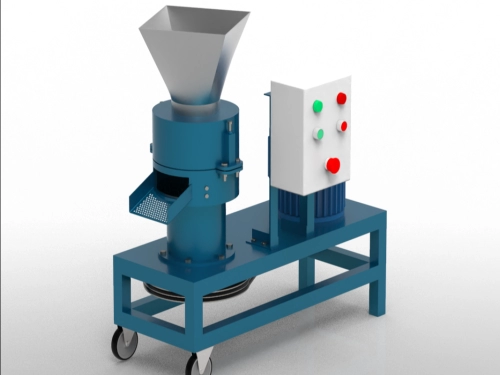
Flat die pellet mills take a different approach. The die sits horizontally. Material spreads directly across its surface. Rollers roll from above, pressing material straight down into the holes. No centrifugal force needed—just direct compression.
This gives flat die machines a natural advantage with tricky materials. Long-fiber straw? Lightweight rice husks? Slightly tough bark? Sawdust with a bit higher moisture? These materials that give ring die mills trouble actually run fine on flat dies. The rollers press straight down—doesn't matter if the material is long or short, light or heavy. If it lands on the die, it gets pressed in.
So if your raw material sources vary—a truckload of sawdust today, corn stalks tomorrow, peanut shells the day after—a flat die mill handles the mix. Switching materials doesn't require major adjustments. Clean it out and keep going.
How They Compare with Specific Materials
Take sawdust. Clean, pure sawdust performs well on both machines. But if you're dealing with sawdust containing a lot of bark—bark has long fibers and some toughness—it tends to wrap around the rollers or clog the feed inlet on a ring die mill. Flat die machines process it more smoothly.
Take straw. Crushed corn stalks or wheat straw have long fibers and low density. In a ring die mill, they struggle to distribute evenly across the die surface. Material piles up in one spot while other areas run empty. Flat die mills don't have this problem. Material spreads on the die, and wherever the rollers pass, material gets pressed.
Take rice husks. These are light, hard, and slippery—poor flowability. In a ring die mill, centrifugal force flings them everywhere, but they struggle to enter the die holes. Flat die mills, with their direct roller compression, actually manage to compact rice husks into solid pellets.
Take moisture content. Ring die mills are sensitive to moisture—go a bit too high and the die holes clog. Flat die mills, thanks to that direct roller pressure, tolerate higher moisture levels better. Wet material? Flat die handles it.
Choosing Based on Your Material
Bottom line: whether you go with flat die or ring die depends on what you're processing.
If your raw material is consistent and uniform—clean sawdust or shavings—and you're aiming for large-scale production, a ring die mill delivers high efficiency and quality pellets.
If your material sources vary, or you're dealing with challenging stuff like straw, rice husks, or bark, a flat die mill saves you headaches. It handles the mix without fuss.
No single machine processes every material perfectly. But match the machine to your material, and your choice gets a whole lot simpler.
Copyright: Copyright belongs to Hengju Machinery! Reprint please indicate the source: https://www.hengjumachinery.com/industry-news/how-do-flat-die-and-ring-die-pellet-mills-differ-in-handling-materials.html
Needs Help? Let’s Get in Touch