Ring Die vs. Flat Die Pellet Mill: How to Make the Key Choice Based on Your Needs?
When faced with choosing a wood pellet mill, ring die and flat die represent two mainstream and core technological paths. They are not simply a matter of one being better than the other, but rather solutions tailored to different production scenarios and requirements. Understanding their fundamental differences is the first step towards making the right investment decision.
Fundamental Structural Difference
The most fundamental distinction between ring die and flat die mills lies in the structure and operation of their core die. In a ring die pellet mill, the die is a vertically oriented, heavy ring with numerous holes. The press rollers rotate horizontally inside it, forcing material from the inner circumference outward through the die holes to form pellets. This structure inherently suits high-intensity, large-scale, continuous industrial production.
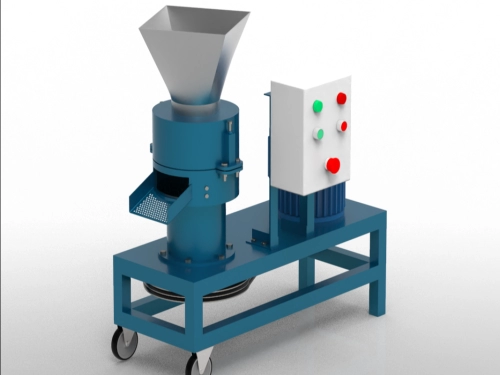
In contrast, the die of a flat die pellet mill is a horizontally mounted disc. Press rollers travel across its top surface, compressing material vertically downward through the die holes. This design is more compact, with a relatively direct drive system, giving it unique flexibility for medium-to-small capacity, batch production, or laboratory environments.
Advantages of Ring Die Pellet Mills
Therefore, the advantages of a ring die pellet mill lie in efficiency and durability. Because the entire ring die can rotate, creating an efficient compression line with the rollers, its output per unit of time is typically higher, and operation is smoother. Its robust ring die structure can withstand greater pressure, offers a long wear life, and produces pellets with excellent density and consistency. It requires stable power (industrial three-phase electricity) and a continuous supply of raw materials. It is the preferred choice for wood processing plants and professional pellet fuel producers pursuing scale and economic efficiency.
Advantages of Flat Die Pellet Mills
The advantages of a flat die pellet mill lie in adaptability and convenience. Its structure is relatively simple, with lower requirements for the installation base. Some models can even operate on single-phase power, and starting up or changing dies is more straightforward. This makes it highly suitable for small farms, workshops, or research institutions that need to process diverse biomass materials for small-batch, multi-variety production. Its investment threshold and operational flexibility are also generally lower.
Key Considerations for Choosing
The key to making a choice lies in a clear examination of your own needs. You can ask yourself the following questions:
Capacity & Scale
How many tons do you plan to produce per day consistently? If your target is clearly above 1-2 tons/day and you aim for long-term continuous operation, a ring die mill is the more reliable choice. If your need is a few hundred kilograms per hour or requires flexible start-stop operation, a flat die mill might be more economical.
Raw Materials & Power
Is your raw material source stable and uniform? Do you have access to stable three-phase power? If yes, a ring die mill can deliver maximum performance. If your raw materials are complex/variable or power is limited, a flat die mill offers greater adaptability.
Investment & Operation
What is your initial budget, and what are your expectations for automation and durability? Ring die mills have a higher initial investment but potentially lower cost per ton in the long run. Flat die mills have a smaller upfront cost and are easier to start with, but may have disadvantages in die life and specific energy consumption when processing hardwoods.
Copyright: Copyright belongs to Hengju Machinery! Reprint please indicate the source: https://www.hengjumachinery.com/industry-news/ring-die-vs-flat-die-pellet-mill-how-to-make-the-key-choice-based-on-your-needs.html
Needs Help? Let’s Get in Touch