How can a Wood Pellet Machine Turn Sawdust into High-Energy Pellets?
A wood pellet machine can transform loose wood waste into hard, uniform pellets. The core of this remarkable transformation is not simple physical crushing, but a precise thermomechanical process known as "pressure forming." The wood pellet machine does not rely on any chemical adhesives; its secret lies in utilizing the inherent properties of wood itself, achieving permanent reshaping under high temperature and pressure.
1. Pretreatment
The success of the entire process first depends on the precise pretreatment of the raw material. Raw materials like sawdust and wood shavings need to be crushed to achieve uniform particle size and dried to strictly control the moisture content to between 10% and 18%. This is the most critical preparation step. Moisture acts like a catalyst—if it's too low, it cannot activate the wood's inherent "binding force"; if it's too high, steam will be generated during subsequent compression, resulting in loose, easily cracked pellets.
2. Compression and Shaping Under High Temperature and Pressure
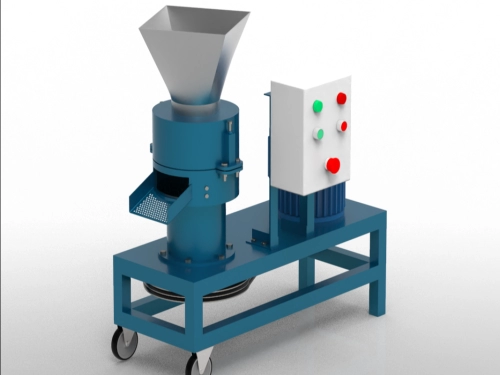
The pretreated raw material is fed into the heart of the pellet machine—the pelleting chamber—where it undergoes its true metamorphosis. The material is forced into a thick steel ring die filled with precise holes. The immense pressure applied by heavy-duty press rollers not only compels the wood fibers to interlock tightly but also generates a crucial temperature of 70-95°C due to intense friction.
This temperature perfectly softens the natural lignin within the wood. At this point, the softened lignin acts as a natural "binder," flowing under high pressure to coat the fibers and permanently bond them into a dense solid. Subsequently, the continuously extruded rod-like material is cut, forming uniform pellets. In short, the machine uses pressure and frictional heat to activate the wood's own binding potential, completing the qualitative change from loose material to formed solid.
3. Cooling and Setting
The freshly extruded pellets are hot and soft in texture and must be immediately cooled and solidified. Through rapid cooling with forced air, the hardness and structure of the pellets are finally strengthened, and residual moisture further evaporates, yielding a stable, durable final product that is easy to store and transport.
Copyright: Copyright belongs to Hengju Machinery! Reprint please indicate the source: https://www.hengjumachinery.com/industry-news/how-can-a-wood-pellet-machine-turn-sawdust-into-highenergy-pellets.html
Needs Help? Let’s Get in Touch