Flat Die Wood Pellet Mill: A Practical Choice for Small to Medium-Scale Biomass Pelleting
In the world of biomass pellet production equipment, the flat die wood pellet mill and the ring die model represent two mainstream technological approaches. Unlike ring die equipment designed for large-scale, continuous production, the flat die wood pellet mill, with its simple structure and flexible adaptability, demonstrates unique practical value in scenarios involving small to medium-scale production, diverse material processing, and limited initial investment.
How Does It Work?
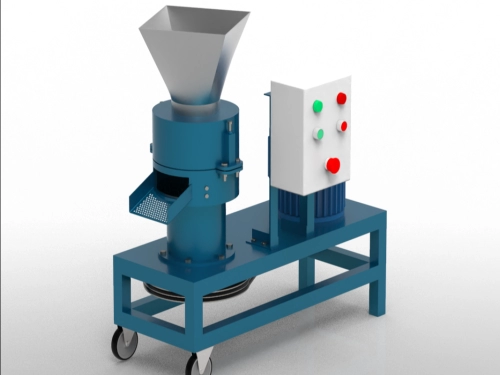
The core working process of a flat die wood pellet mill is a form of vertical compression molding. Its main component is a horizontally placed circular die—the flat die—which is covered with rings of forming holes. Above the flat die are several rotating press rollers. When pretreated raw material falls onto the flat die surface through the feed port, the rotating rollers pass over it, forcibly pressing the material into the forming holes of the flat die. The material is continuously compressed within the holes, forming dense cylindrical strips that are extruded from the bottom of the die. These strips are then cut to the required length by cutters, finally emerging as uniform pellets.
Just like the ring die model, this process requires no chemical adhesives. It relies on high temperature and pressure to soften the lignin, which acts as a natural binder. The difference lies in the fact that the material spreads horizontally on the flat die, with rollers pressing down from above. This vertical force application often provides better adaptability for some lightweight or long-fiber materials.
Main Advantages of the Flat Die Wood Pellet Mill
The first advantage is its simple structure and affordable cost.
The overall structure of a flat die wood pellet mill is more straightforward than that of a ring die model. It lacks complex transmission systems and precise ring die mounting structures, resulting in relatively lower manufacturing and maintenance costs. This makes its initial purchase cost significantly lower than ring die equipment with comparable capacity. For small processing operations or individual users just starting in pellet production with limited funds, this presents a much more accessible entry point.
The second advantage is greater flexibility in raw material adaptability.
Due to the horizontal die and vertical feeding method, material relies on gravity to settle on the die surface, where rollers directly compress it. For some raw materials with low bulk density, long fibers, or slightly higher moisture content—such as rice husks, straw, bark, or even some moist materials—flat die models often handle them more readily than ring die machines. They are less prone to clogging and easier to adjust, making them suitable for production scenarios where raw material sources are inconsistent and frequent changes in material type are needed.
The third advantage is convenient operation and maintenance.
Disassembling and assembling the die and press rollers on a flat die wood pellet mill is relatively simple. Changing dies with different hole sizes or cleaning out residual material doesn't require complex tools or extensive operating experience. For users without dedicated maintenance personnel, this means routine upkeep can be handled independently, reducing reliance on external technical support. Additionally, flat die models have more flexible power requirements; some smaller versions can even run on single-phase electricity, allowing normal operation in rural areas or locations with limited power infrastructure.
The fourth advantage is suitability for small-batch, multi-variety production.
Flat die wood pellet mills start up and shut down relatively quickly, and cleaning between material changes is easy. Unlike large ring die lines that need long, stable runs to be economical, flat die models can flexibly switch production. If you need to make wood pellets one day, straw pellets the next, and feed pellets the day after, a flat die model accommodates this flexibility, avoiding production stoppages and material waste caused by changeovers.
Where Is It Best Suited?
Flat die wood pellet mills are mainly used in scenarios where maximum output isn't the primary goal. In rural areas, farmers can use them to process their own corn stalks, rice husks, or sawdust into fuel pellets for heating, achieving fuel self-sufficiency. In small wood processing mills or furniture factories, they can handle daily sawdust and shavings, turning waste into value and reducing disposal costs. At feed processing points or farms, they can compress various formulated livestock feed or bedding material. They are also commonly used in some research institutions or educational settings as experimental equipment for studying biomass densification processes.
Summary
In summary, the flat die wood pellet mill doesn't aim to surpass ring die equipment in output and efficiency. Its value lies in meeting the diverse needs beyond large-scale continuous production in a simpler, more flexible, and more economical way. For users with scattered raw material sources, limited production scale, or the need to frequently adjust product types, choosing a flat die wood pellet mill often means opting for a lower starting point and a more adaptable production method.
Copyright: Copyright belongs to Hengju Machinery! Reprint please indicate the source: https://www.hengjumachinery.com/industry-news/flat-die-wood-pellet-mill-a-practical-choice-for-small-to-mediumscale-biomass-pelleting.html
Needs Help? Let’s Get in Touch